
Starting Solids Safely: A Registered Dietitian Answers Your Top Questions [VIDEO] 

What to know before you start solids
Wondering when and how to safely start solids with your baby? As a mother of two, I’ve been through the process of introducing solids with my own children, and I know firsthand there’s a lot to think about.
Here’s what to know about readiness signs, first foods, introducing allergens, and the feeding questions parents ask me as a registered dietitian most often.
Key takeaways
- Most babies are developmentally ready for solids around six months, though signs of readiness matter more than the calendar date
- Iron rich foods should be a priority for first foods
- New research supports introducing common allergens early, one at a time
- Start with small amounts, one to two tablespoons once daily, and build up gradually
- Gagging is normal and noisy, choking is silent, know the difference
- Sticking to Ellyn Satter’s Division of Responsibility can help ease picky eating
When is a baby developmentally ready to start solids?
A baby is developmentally ready to start solids around the six month mark, according to Health Canada. Babies are generally not ready before four months, so that’s the earliest cutoff.
Beyond age, we look for a few developmental signs of readiness:
- Good head and neck control
- Able to sit upright with minimal support
- Showing interest in food, like reaching or grabbing when food is nearby, or opening their mouth
- Able to move food from the front of the mouth to the back and swallow
What types of foods are good first options?
Whether you breastfeed or formula feed, the iron stores babies are born with start to deplete around six months. This is why we begin what’s called complementary feeding around this time, so babies get used to eating while maintaining their nutritional stores.
Iron is one of the first nutrients to prioritize. Good iron rich first foods include:
- Iron fortified infant cereals
- Protein based foods like beef, dark poultry, lamb, fish, eggs, beans, lentils and chickpeas
It’s also worth including nutrient dense foods like avocado, yogurt, sweet potato, oatmeal and banana.
A helpful rule of thumb for texture: if a piece of food can be gently pressed between two fingers, it’s soft enough for your baby to mash between their gums, no teeth required yet.
There are a couple of ways to approach starting solids. The traditional method moves through texture progression, from purees to mashed foods to soft finger foods to whole foods as your baby develops. There’s also baby led weaning, where babies start with foods that are prepared safely for their age but skip the pureed or mashed stage entirely. Which approach you choose comes down to your comfort level and what your baby is ready for. Either way, by six months we want babies getting more variety in their diet so they aren’t missing key nutrients.
What foods should you avoid?
One food to avoid entirely before 12 months is honey, including cooked or baked honey, because of the risk of infant botulism. It’s also best to prepare foods with little to no added salt or sugar.
It’s also important to avoid hard, small and round, or smooth and sticky foods, since these can pose a choking risk. This includes things like whole grapes or cherry tomatoes, whole nuts, popcorn, hard candy, hot dog rounds, and thick globs of peanut or nut butter (nut butter is fine thinned out and spread thin).
How can parents introduce allergens safely?
Canadian Paediatric Society recommends offering allergens starting around 6 months. Newer research shows that delaying the introduction of allergens can actually have the opposite of the intended effect, and that early introduction is what we want to aim for.
There are nine major allergens: peanuts, tree nuts, eggs, cow’s milk, soy, wheat, sesame, fish and shellfish.
A few guidelines for introducing them:
- Introduce one allergen at a time
- Start with small amounts and build up gradually to see how your child tolerates it
- Avoid combining allergens together, so you know exactly which food caused a reaction if one happens until you are sure your child does not have a reaction then you can combine common allergens together
- Keep giving the food regularly once it’s been introduced, roughly one new allergen per week is a good pace
Watch for signs of a reaction. Mild reactions can include hives, vomiting, swelling or a rash. More severe reactions include difficulty breathing or wheezing. If you see signs of a severe reaction, seek emergency medical care right away.
How much do babies eat when starting solids?
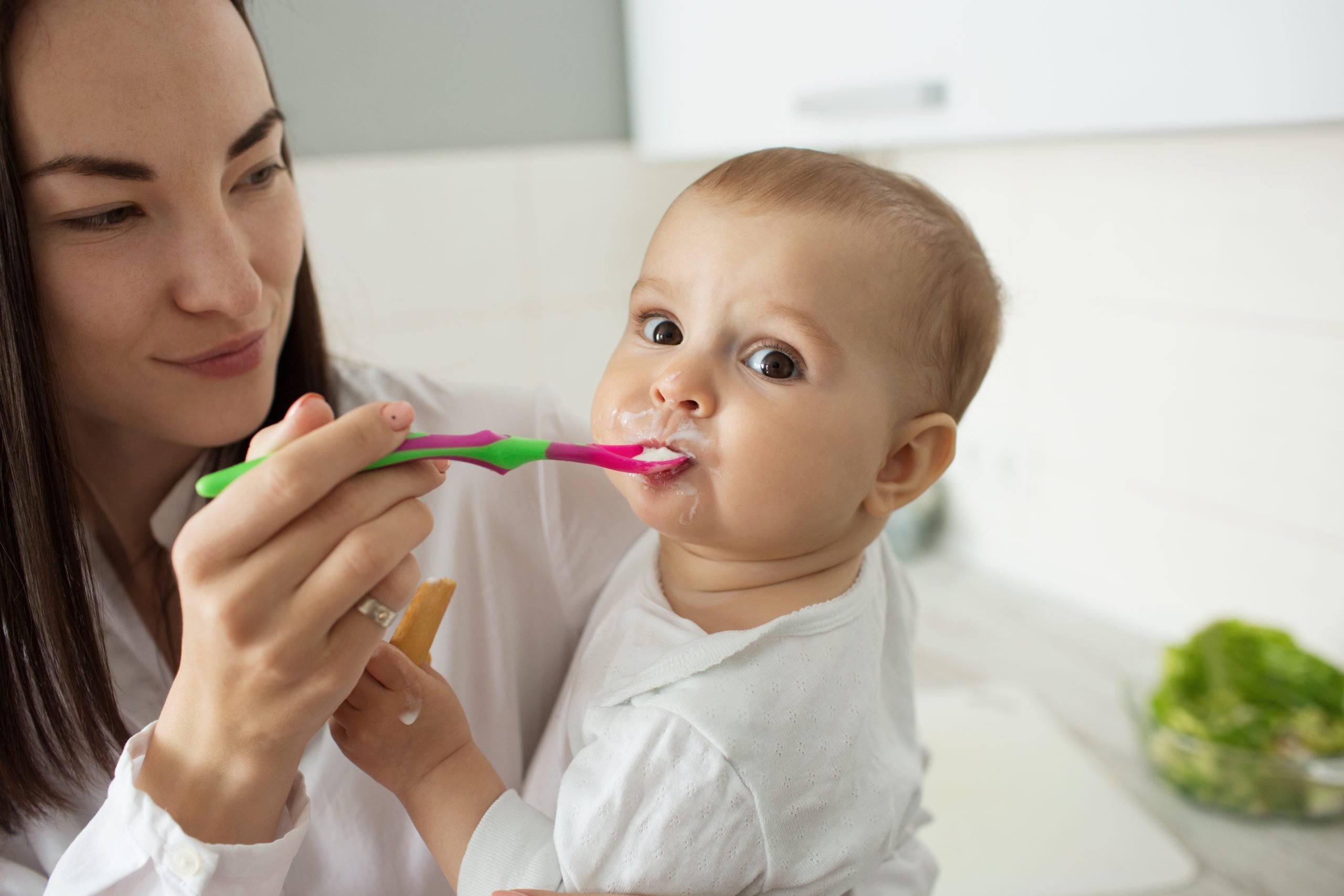
At six months, a baby’s stomach is still very small, and solids are meant to complement, not replace, breast milk or formula. Early on, this stage is as much about skill development and exploring food through taste, touch and senses as it is about volume.
Don’t worry if your baby doesn’t eat much in those first tries, that’s completely normal. Start with about one to two tablespoons once daily, then gradually increase the frequency and amount as your baby grows and naturally moves toward eating more whole foods more often. By 12 months, most babies are eating multiple times throughout the day.
Feeding progression by age
6 to 8 months
Frequency: Start with 1 meal per day and gradually work toward 2–3 meals per day as baby becomes more comfortable with solids.
Amount: Begin with small amounts, about 1–2 teaspoons, increasing gradually according to baby’s appetite. There is no need to make baby finish a particular amount.
Textures: Start with smooth, mashed or very soft foods, then progress quickly to thicker, lumpy textures. Unless you are choosing to follow baby led weening which allows babies to start eating soft foods that can be squished between your thumb and pointer finger in full size pieces. By 9 months, lumpy textures should be well established.
Iron is a priority: Offer an iron-rich food at each meal as solids increase. Examples include iron-fortified infant cereal, finely minced or shredded meat, fish, egg, lentils, beans, tofu and other meat alternatives.
Variety: Introduce vegetables, fruits and grain foods alongside iron-rich foods. Gradually offer a variety of flavours and textures rather than relying mainly on prepared purées.
Dairy: Full-fat plain yogurt, cottage cheese and pasteurized cheese can be introduced as foods. These complement, not replace breast milk or infant formula.
Allergens: Common allergenic foods such as peanut and well-cooked egg can be introduced around 6 months in an age-appropriate form. Once tolerated, continue offering them regularly.
Drinks: Breast milk or formula continues to provide most fluids. Small amounts of water can be offered from an open cup with meals.
Parent tip: Follow baby’s hunger and fullness cues. Some days baby will eat very little and other days considerably more; appetite naturally varies.
8 to 10 months
Frequency: Aim for 3 meals per day, with additional breast milk or formula feeds according to baby’s usual hunger cues.
Amount: Portions will gradually increase from a few spoonfuls toward approximately ¼–½ cup per meal, but appetite should determine how much baby actually eats.
Textures: Move from mashed/lumpy foods to soft, finely chopped, shredded, minced or finger-sized pieces. Baby should increasingly be able to pick up food and feed themselves as the pincher grasp becomes a skill they should have around 9 months old. Continue providing a wide variety of foods if using baby lead weening method.
Iron-rich foods: Continue offering iron-rich foods at each meal or several times each day. Pair plant-based iron sources with vitamin-C-rich foods such as berries, kiwi, broccoli, tomatoes or peppers to support iron absorption.
Family foods: Offer modified versions of the family’s meals, soft, appropriately textured and without added salt or excess sugar.
Self-feeding: Encourage finger foods and an open cup. Messy eating and exploring food with the hands are normal parts of learning to eat.
Dairy: Continue offering full-fat yogurt and pasteurized cheese as foods. Dairy should not crowd out iron-rich foods as this impacts the absorption of both nutrients.
Milk: In Canada, homogenized 3.25% cow’s milk may be introduced as the main milk source between 9 and 12 months. It does not need to wait until exactly 9 months, nor is “eating iron-rich foods well” the formal trigger; however, a good variety of iron-rich complementary foods should be established because cow’s milk contains little iron. If cow’s milk is introduced, avoid excessive amounts. Health Canada recommends no more than 750 mL/day.
Breast milk/formula: Continue breastfeeding as desired. If using infant formula, continue it as the primary milk source until transitioning to cow’s milk within the recommended 9–12-month window.
Parent tip: By 9 months, babies should be regularly experiencing lumpy and textured foods rather than remaining on smooth purées.
10 to 12 months
Frequency: Aim for 3 meals per day, plus breast milk or formula as needed. Some babies may also benefit from a small snack as they approach 12 months, depending on appetite and the family’s routine.
Amount: Many babies can manage roughly ½ cup per meal, but this is only a guide. Let baby’s hunger and fullness cues determine the amount.
Textures: Offer a broad range of textures, soft chopped foods, shredded meat, mashed foods, soft finger foods and foods with small lumps. By 12 months, work toward foods that resemble appropriately modified family meals.
Iron-rich foods: Continue to include iron-rich foods at each meal or several times per day. This remains particularly important during the transition to cow’s milk.
Family meals: Baby can increasingly eat what the family eats. Modify foods to make them soft and appropriately sized and avoid adding salt or sugar specifically for baby.
Self-feeding: Encourage independent eating with fingers and an open cup. Spoons can also be offered for practice.
Milk: If cow’s milk has been introduced, use homogenized 3.25% milk. Keep milk intake moderate so it does not replace meals or iron-rich foods; Health Canada recommends no more than 750 mL/day for young children.
Breastfeeding: Breastfeeding can continue beyond 12 months for as long as parent and child wish. At 12 months this is no longer the main source of nutrition, it provides comfort and other benefits that come through breastmilk such as immune system support.
Variety: Aim for regular exposure to vegetables and fruit, whole grains, protein-rich foods, iron-rich foods and full-fat dairy foods.
Safety: Continue avoiding choking hazards such as whole grapes, whole nuts, popcorn, hard raw vegetables, chunks of meat or cheese, and spoonfuls of nut butter. Prepare foods in an appropriately soft and manageable form.
Parent tip: By the end of the first year, the goal is not for every meal to look perfect but itt is for baby to be comfortable eating a variety of nutritious family foods, managing different textures, and responding to their own hunger and fullness cues.
What are common feeding concerns parents worry about?
Appetite changes. It’s common to worry when a child suddenly seems to eat less. Appetites shift based on growth and comfort with new foods, and it can take several exposures before a child accepts a new food. Don’t give up, and remember solids aren’t your baby’s main source of fuel yet at this stage.
Gagging versus choking. This is one of the biggest fears for parents. Gagging is noisy, if your baby is making sound while eating, that’s actually a good sign their gag reflex is working and they’re managing the food. Choking is silent and is the true danger sign, that’s when you’d step in right away. Staying calm during gagging matters too, since a panicked reaction from you can sometimes turn gagging into choking.
Constipation. This is common once solids are introduced, since it’s a big change for a baby’s digestive system. Keeping up fluids helps, you can start offering a small amount of water after six months. Foods like pears, prunes, vegetables and legumes can also help keep things moving. Gets tips if you have a constipated toddler.
Picky eating. Exposure matters here too, it can take 15 plus interactions with a food before a child accepts it, so try not to put pressure on mealtimes. Everyone has different preferences, adults included, so keep offering a variety of foods, textures and tastes, and eat together as a family when you can. Kids notice what’s on our plates. Learn more about what to do if you have a picky eater.
It also helps to remember Ellyn Satter’s Division of Responsibility in feeding: it’s your job as the parent to offer the food, and it’s your child’s job to decide how much of it they eat. Taking the pressure off tends to make kids more relaxed and more willing to try something new.
If you have any further questions or concerns, feel free to comment below. And if you’d like some extra support on your infant feeding journey, reach out to us at Health Stand Nutrition, we’re here to help.
Looking for nutrition support as you start introducing solids to your baby?
Ready to feel confident starting solids? Our Registered Dietitians can provide personalized guidance on when and how to introduce foods, support balanced nutrition, and help you navigate common feeding questions along the way.
Reach out to our team to book a free discovery call and learn more about our nutrition programs and specialized dietitians.
Shauna Kime
Registered Dietitian & Online Nutritionist - Weight Concerns, Women’s Health, Diabetes & Meal Planning
The first thing you will notice about Shauna is her contagious optimism, energetic personality and zest. Shauna loves teaching and has a heart full of compassion and empathy for helping clients work through health concerns. Shauna specializes in healthy cooking, diabetes, cardiovascular health, weight concerns and womens health. Read more
